Molly Rice and Rebecca Olson were the lucky riders whose names were drawn as the SFP Chapter’s AA riders for this year’s clinic with Patty Mayer.
On March 28-29 CDS hosted the Northern Adult Amateur clinic at Michele Vaughn’s Starr Vaughn Equestrian Center in Elk Grove. Michele rolled out the red carpet for the horses and riders, and everyone had a great time learning new skills, meeting like-minded people, and being immersed in the sport. This year’s clinician, Patty Mayer is a seasoned FEl competitor, coach, and trainer, who paired a great sense of humor with deep knowledge, making the weekend a fun, educational event.
But I’ll let this year’s riders for the SFP Chapter provide their own feedback:
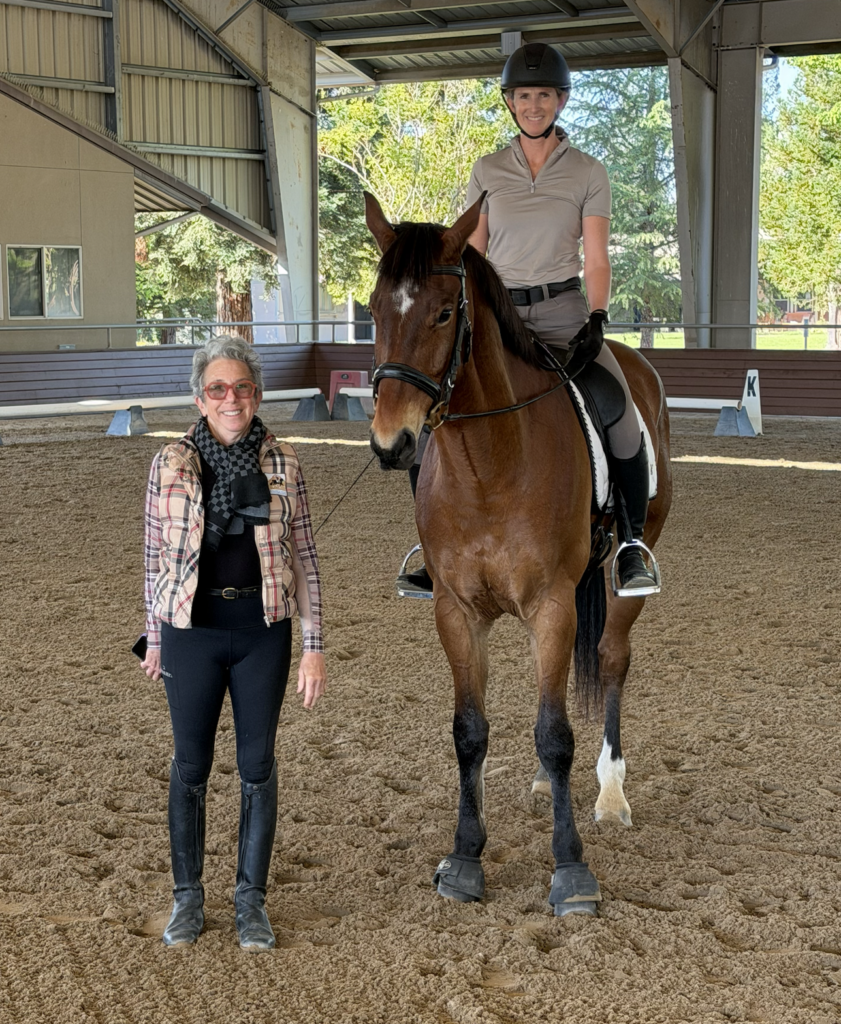
Molly Rice, Not Included, and Patty
I had a great weekend riding with Patty Meyer at Starr Vaughn in the CDS Adult Amateur clinic. I am grateful to my San Francisco Peninsula chapter for sponsoring me, to Michele and Genay Vaughn for hosting us at their incredible facility and to Vicky Von Artz for organizing everything. Patty Meyer was inspirational to be around and to learn from. Her goal of bringing the fun back into dressage was evident throughout the weekend. I met some nice fellow dressage fans and really enjoyed learning from Patty.
Patty helped me and my horse Not Included (Nico), with both simple, concrete ideas of how to improve our movements and accuracy (no more 18m circles!) and longer-term plans of how to build Nico’s core. I was riding a fairly green horse with huge movements and was struggling with holding my position and keeping him consistent. He is challenged with collection and holding the angle and bend in lateral work. She gave me some exercises to work on to slowly build his strength over time. She also gave me some suggestions of how to build my own core strength so I can better support Nico and stay centered.
It was really nice to meet some new people and get some quality time with my horse in such a beautiful setting. Starr Vaughn in an idyllic horse space with top notch facilities. Patty Mayer was both fun and easy to learn from. I really enjoyed getting to know her and the other riders. Thank you, CDS for giving me this opportunity and for continuing to support amateurs in the sport!
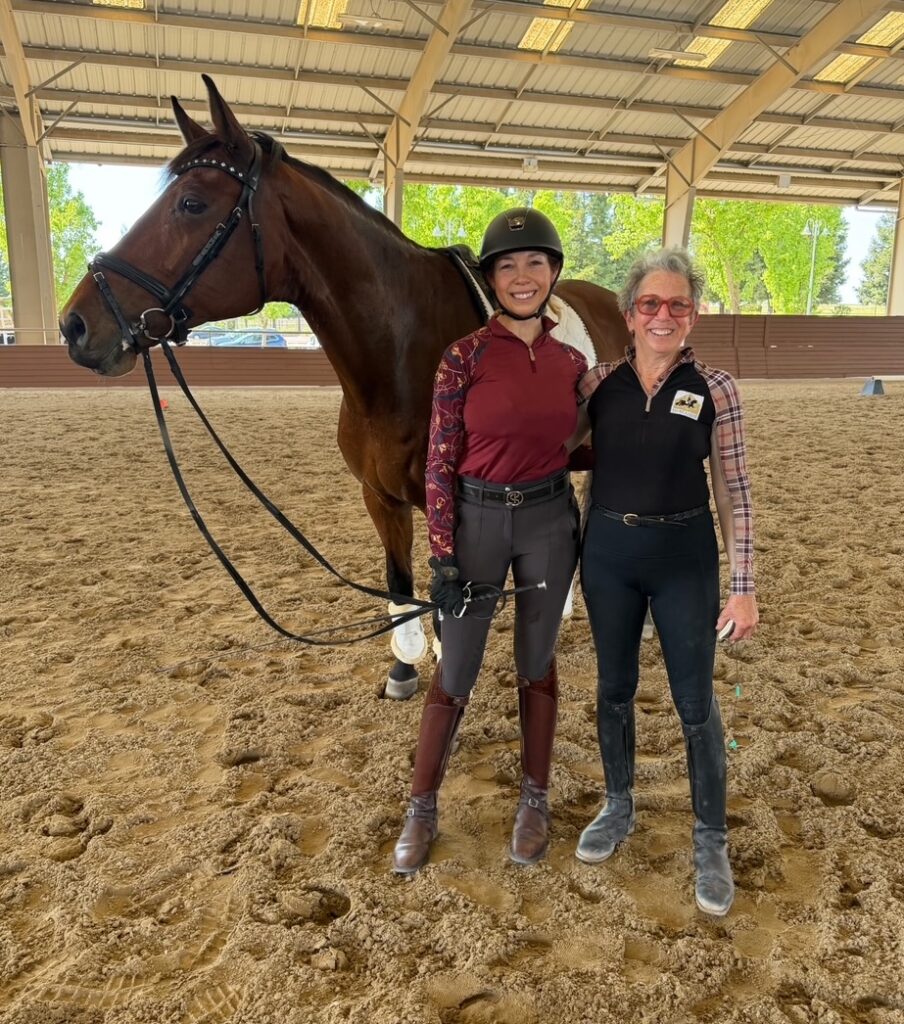
Rebecca Olson, Frankie Goes to Hollywood, and Patty
It was an honor to participate in the AA Clinic with Patty Mayer at the lovely Starr Vaughn. I came away from the weekend both inspired by the energy from Patty and the rest of the AA riders, and equipped with a set of new insights and tools to help our 3rd level training. Some highlights of our learnings below:
It was an honor to participate in the AA Clinic with Patty Mayer at the lovely Starr Vaughn. I came away from the weekend both inspired by the energy from Patty and the rest of the AA riders, and equipped with a set of new insights and tools to help our 3rd level training. Some highlights of our learnings below:
- The importance of riding correct walks – eg, the difference between an extended walk into the connection vs. a free walk with a lower poll (but not lower than the shoulder!) and always into contact (“marching back to the barn to get grain”). Patty reminded us that “all walks are double coefficients so buy a nice one!” but also that “you still have to ride it.” A medium walk she reminded us has the poll as the highest part. A collected walk is a walk “from which you can do anything” – eg, rein back, piaffe or trot.
- The importance of a rider’s position (Patty shared practical tips that work even if you aren’t a 6 foot tall German man). Patty emphasized the following points:
- Instead of the old wisdom “hands above the withers and 2 inches apart”, Patty emphasized that the hands should not be wider than the horse’s shoulders and a little in front of the saddle pad.
- Patty emphasized the importance of self carriage to encourage a horse to lift its own back and improve all of the gaits – eg, “suck your bully button to your spine, elbows back, sternum up and lock your shoulder blades together!”
- Patty reminded us how a proper leg aid is from the inside of the calf (the spur is there to correct an ignored leg aid, not substitute for one!) so a rider’s legs should be “long long long” with “knees in, calves on”
- A rider’s eyes should be where the horses eyes are (eg, to the left if you are half passing left)
- You create collection and balance the horse back on its hind legs by squeezing with your calves and not changing your hands. “When you compress your body, the horse compresses its body.” Then, when you want to go forward, you open your hips and stretch up. “When you stretch up, the horse stretches too”
- Breath is a tool you can use – inhaling for upward transitions and exhaling for downward ones.
- The importance of knowing geometry – arena geometry, that is. Specifically, every rider should know the unintuitive distance between letters – eg, 6 meters from the corner to F, but F to P is 12 meters. Apparently cowboy dressage is smarter because they place the same distance between all the arena letters. And every rider should have acronyms that help them remember all the letters of the arena (Patty’s are
“My Rabbit Bit Peter Fonda”, “His Sister Eats Vegetable Kebabs” and “Cousin George Inhales Extremely Large Dandelions Always.” - The key to dressage: being transitions within the gait. Patty shared “if you think you’re doing enough, do 20x that.” And that key showed in the clinic exercises. Once I had a great renver or traver or half pass, Patty would ask me to change the trot (eg, move from a working trot to a collected trot, then to an extended trot, then back to a working trot). It seemed it was never enough to hang out in a lateral exercise when you could be multi-tasking by adding transitions within the gait.
- How to create more collection. Patty reminded us how shoulder in starts 2nd level as it requires a collected trot, and it will also HELP horses collect the trot when done correctly. Riding corners with a very active small trot can also help. Voltes in canter work done correctly (turning with the outside reins and not letting the horse’s butt swing out) can help collect a big canter. Another exercise that is helpful is to do a big and active walk pirouette and then transition into a canter pirouette, for 4-5 strides, then back to a walk pirouette. This way, a horse must sit in the canter.
- How to create a more forward horse: give them something to look forward to. For example, put a pole on the ground and then do nothing. If the horse slows down when you do nothing, then get aid her forward but don’t nag – no one likes a nag! When things go well, rather than giving your horse a walk break, take a “victory gallop” around the arena in 2 point so that your horse gets in the habit of going forward after a movement instead of quitting.
- The key to the stretch circle: show a difference. Therefore, you need to start with more collection so that the horse wants to stretch. Then you lengthen the outside rein first, but slowly. By the time you hit the quarter line, you should be fully stretched. By the time you hit the last quarter line, you should start to collect. Apparently Ashlyn De Groot does an amazing stretchy circle (if you want to watch one ridden correctly).
- The importance of experimentation in dressage: Patty calls dressage “a grand experiment” in that every horse and rider combination needs different things based on confirmation and personality. When things fall apart, it’s ok to halt and organize.
- The importance of components: when something isn’t working, break a movement down into its component parts. For example:
- If you’re trying to half pass to the right but the horse is losing the bend, do a half pass at the walk and then, once you have regained the bend, return to the trot.
- If your horse does not understand how to do haunches in off the wall, start with a leg yield to move him laterally along the wall, and then get the correct inside bend in the shoulders once the haunches are inside.
- If you need to increase bend in the half pass, half pass to the right and then leg yield left, then half pass right back again.
I love how Patty observed how confusing it is to be a horse (“four legs and someone on top of them”) so our job is to make it simple for them so they can learn it better.
- On the importance of collaborative riding: the key is to get your horse on your team. You need to make it fun for them, not just work. “Horses love when you are proud of them. If you reward with your voice and your soul, they will become your partner.”
- On the importance of minimalistic riding: the key to great dressage horses is light aids with consequence and action if a horse ignores them. For example, come and go with the leg and only use a spur if the horse doesn’t respond. A whip and spurs are not an aid – they are a reminder of an aid that should be used sparingly. Then go back to the inside of the calf leg aid, coming and going. You don’t want to move unless there is some reason to move. “Say YES to your horse by doing nothing – give her some peace!”
- Last but not least, the secret to keeping an earbud in your ear: run it through your ponytail tie if you have one. Brilliant!
Patty shared “I’m not a genius. I’ve just had the privilege of learning from geniuses as she listed the extensive list of dressage masters she trained with and continues to clinic with.” Genius or not, Patty has chronicled the wisdom and extensive library of exercises with the same precision and comprehensiveness she has applied to her equally impressive legal career. As an attorney, she ascended to one of the top entertainment lawyers in LA, much as she ascended as an AA rider under Hilda Gurney’s program to become 11th in the nation with her first Grand Prix horse. Even if Patty’s exercises are a compilation from others, I found the way she teaches them is pure genius nonetheless.