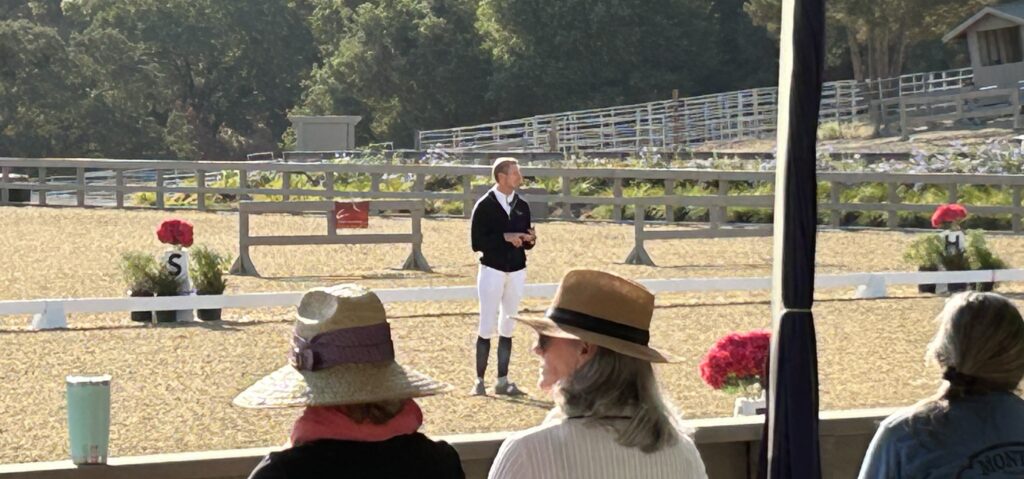
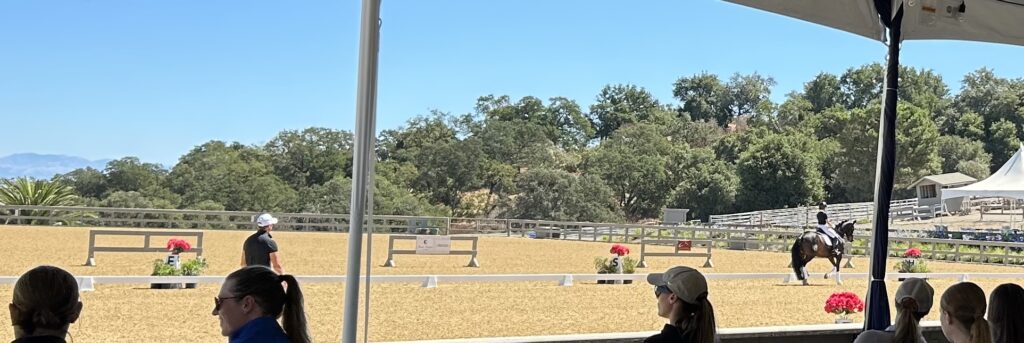
On September 13-14 the San Francisco Peninsula Chapter of CDS presented the first U.S. Masterclass with Swedish Olympian and World Cup champion, Patrik Kittel. The event was held at the Horse Park of Woodside and included young horses up to Grand Prix, giving Patrik the opportunity to share his training process as well as demonstrating his talents by riding one of the horses each day. The event was well attended, with an appreciative audience responding positively to the numerous improvements and insights provided by Patrik over the course of the two days.
Over the weekend Patrik demonstrated why he’s a multiple Olympian and European champion. With a toolbox full of solutions, he quickly rewarded positive changes with an enthusiastic “super”, and when things really went well, “wow” or “mega!”. His skill at bringing out the best with each horse and rider in an effective and positive way became a common theme and made the event an inspirational weekend for auditors and riders alike. A self proclaimed “talker” Patrik readily shared numerous antidotes about himself, both good and bad, noting that he still gets nervous at shows, and how he came in last at his first young rider championship. Patrik’s willingness to answer any and all questions with thoughtful answers, in addition to posing for endless photos with a ready smile made him a crowd favorite.
- “Keep it simple”
The first session focused on the young horse, with two talented 5 year olds. The horses were quite different in build and temperament and gave Patrik an excellent starting point. With the young horses he likes to keep it simple, working to maintain a soft contact that allows the horse to follow the rider’s hands. With simple changes in tempo Patrik started to shape and refine the gaits and connection. Micro transitions were made in each gait, going forward for a few steps and then back, asking the horse to stay attentive and looking for what’s next. Riders were asked to reward the horse with pats and neck stretches to let them know when something was done correctly. A constant comment was “correction should follow reward”, keeping the horse responsive and quick to the aids. By making small changes in the tempo and direction, the horses became more attuned to the rider, seeming to ask “what do you want, what should we do”, in a positive way. By the end of the session both horses were showing more swing in the back and improved gaits. Patrik noted that questions the rider should be asking themselves during the training at this level include: “do I work equally to the left and the right?” and, “is there good quality in each exercise, or am I just completing it?”
- “Ignore the bad, reward the good”
The next group of two horses were working on third level and the same basic concepts were incorporated again, working to create light, attentive horses that responded quickly to the aids while staying loose and through. Patrik’s natural empathy for the horses was evident as he asked riders to vary the tempo in the work to keep it interesting for the horses and keep from getting stuck doing one movement if things are not going well. “They have to keep growing, but we have to keep them sound and interested” Patrik commented. “Don’t get stuck thinking about the level, it’s education and training in general”. Patrik was quick to think of exercises that helped solve problems with each horse, such as using shoulder-in into the canter transition to help maintain the bend and engage the inside hind leg, or keeping them sensitive to the rider’s leg by making the aid shorter and quicker and then taking the leg off. “The more you have to put the leg on, the more the horse will go against the leg” he commented. If a horse was slow to the leg, Patrik suggested starting the warmup in canter, as it was easier to get the horse forward and responsive, which will also help to improve the trot work.
- “You have to manage your own team and timing”
On the second day Patrik was joined by Genay Vaughn during the lunch break as the two of them discussed what it was like competing at the World Cup in Basel Switzerland. It was great to get a behind the scenes view of the competition, including the fact that being in the middle of the city, they had to walk their horses by a soccer field on the way to the arena! Patrik talked about developing the ability to go into the zone when he hears the judges bell, letting him focus on the ride and tune out any external distractions. When he completes his final salute he says it feels like he “wakes up” and is suddenly aware of the crowd, and what’s happening outside the arena. He also advised that it’s up to you to do what’s best for the horse in the lead-up to the test, such as warm-up time, how the horse will respond to different situations, and what you will encounter at the facility. Genay added that having a strong support team was also incredibly important and takes a lot of the stress off the rider.
- “Something intense, then a stretch”
After lunch the focus shifted to the FEI level and two horses schooling Prix St Georges. It was interesting to see how Patrik worked through any training issues, often by segmenting the movements to keep the horses listening. One horse was having trouble with the tempi changes and Patrik first had the rider work on the quality of the canter, coming almost to a trot, then going forward again, with a light quick aid, keeping the horse motivated and listening. Once the canter was steady and light in the hand, Patrik had the rider start across the diagonal, staying straight and “with the rider” while maintaining the same quality in the canter. If the horse started to anticipate or rush, a circle was made, breaking up the movement and keeping the horse focused on the rider. Patrik consistently had the riders reward any correct work with forward lightness, more than once having the riders come to a two-point in the canter to get out of the saddle. “Don’t get stuck doing one movement over and over” he added, “make it interesting for the horse by varying the tempo and direction.”
Patrik also spent time working on the test entrance at A, coming straight down the centerline with a square halt, maintaining a steady contact. “This is what makes you stand out,” he noted, “technically better beats fancy. If you make a good entrance with a square halt, the judge is more likely to give you higher marks on the next movement”. The horses were asked to come to a square halt, and if a correction needed to be made, they were asked to take a step forward, never back. If they were having trouble in the canter, he took them back to the trot, or even the walk, until the horse understood the question. A simple movement, but something that will set the tone for the rest of your test.
- “Hotness with a focus”
The last session included an established Grand Prix horse. Starting with basics Patrik worked to lengthen the walk by coming to walk from trot for a few strides, and quickly back to trot, explaining that the walk will maintain that forward energy from the trot, opening up the stride. It was easy to see the improvement as the work progressed. Much of the basic exercises focused on maintaining a steady connection and push from the horse, so the rider feels as if they are being pulled forward. Again, small, quick transitions helped to maintain this connection and forward attitude with the horse. Working on the pirouettes Patrik explained that he likes to ride the movement feeling that at any moment he could go forward out of the turn, as people tend to focus on turning and the horses often get quicker and lose the connection. Working on the passage to piaffe, Patrik worked on maintaining the same tempo in both gaits, smoothly going back and forth, building on the collected trot to passage. The horse displayed some lovely movements in a calm, positive way. Patrik said he likes to end the work when the horse is still willing and the movement has gone well. “That way they come back the next day with a positive attitude and are not sore in the body”.
At the end of both days Patrik was kind enough to ride one of the Grand Prix horses. His ability to quickly put the horse at ease and form a partnership was evident. Using micro transitions, quick, quiet aids and soothing vocal commands, Patrik took the horse through many of the movements at this level. If the horse had any issues, Patrik was quick to note that it was his fault, as he worked to understand how the horse liked to be ridden, not the other way around. His ability to bring out the best in a quiet, soft way was inspirational, along with his quick praise for the horse’s ability and talent. As the horse’s gaits and responsiveness improved, we heard Patrik’s positive remarks of “super” and even some “wows!” throughout the ride. It was obvious how Patrik has successfully trained so many horses to Grand Prix, many of whom are still actively competing years later.
Our thanks go out to Patrik for coming to California and sharing his talents with us, it was an educational and enlightening weekend!
For a full list of the horses and riders participating in the SFP Masterclass go to:: www.sfpmasterclass.com/riders-horses
- Kari Browne
